Preparedness · 9 min read
The Prepper Water Gap: Months of Food, Days of Water
By Jason Preston, Founder · June 2026
Walk into most serious preppers' homes and you'll find months of food, methodically stored and rotated. Ask how much water they have, and it usually gets quieter. One gallon per person per day — FEMA's floor — adds up to over half a ton of water for a family of four for a single month.[1] Stored water is a countdown. The fix isn't more jugs — it's adding a renewable layer that keeps producing clean water after the barrels are empty. See the portable system →
The Pantry Is Stocked. The Water Isn't.
Walk into most serious preppers' homes and you'll find something impressive: shelves of freeze-dried meals, vacuum-sealed grains, canned goods stacked in rotation order. Months of calories, sometimes a year or more, built up deliberately and stored properly.
Ask how much water they have on hand, and the conversation usually gets quieter.
The math on food storage is intuitive — calories per day, days of supply, total weight. The math on water is less intuitive, and when you work it through, it reveals the single most common gap in otherwise well-built plans: families who have prepared for months of food but only days of water. This isn't a criticism. It's a structural problem worth solving calmly.
Run the Numbers
FEMA's Ready.gov guidance is straightforward: store at least one gallon of water per person per day, and work toward a two-week supply for each member of your household.[1] The CDC echoes the same floor of one gallon per person per day.[2]
One gallon is a survival floor, not a comfort level. It covers minimal drinking and basic sanitation — a single low-flow toilet flush is 1.6 gallons on its own. For comparison, the EPA cites USGS data putting the average American's actual home water use at 82 gallons per person per day.[3] That gap — between 1 gallon (the emergency floor) and 82 gallons (normal life) — is where most plans quietly break down.
Work it out for a family of four planning a 30-day supply at the survival minimum:
- 1 gallon × 4 people × 30 days = 120 gallons
- At 8.34 pounds per gallon, that's 1,001 pounds[4] — roughly half a ton
- Physically, about 2.2 full 55-gallon drums, each near 500 lbs loaded
And that's the floor. It covers drinking and minimal food prep — not hygiene beyond the basics, not pets, and not the fact that freeze-dried and dehydrated foods, the backbone of most long-term pantries, require clean water to rehydrate. Eating them dry raises your body's water demand rather than lowering it.
Stored Water Is a Countdown, Not a Plan
Here's the part that doesn't appear on most food-storage checklists: stored water has a maintenance cost. FEMA and the CDC both advise replacing home-stored tap water every six months.[2] Not because water "expires" — pure water doesn't — but because containers can pick up flavors and trace compounds over time, and once opened, water can grow contamination within days. Many households that "have water stored" discover on inspection that their containers haven't been rotated in years.
Now add the municipal grid. The U.S. and Canada experience roughly 260,000 water main breaks a year — about 710 every day.[5] Boil-water advisories follow main breaks, pressure losses and contamination events, not just declared disasters; the EPA dedicated a 2024 Report to Congress to how common they are across systems of every size.[6]
Floods compound it. A 23-year analysis of U.S. surveillance data published in the CDC's Emerging Infectious Diseases journal found that exposure to tropical-storm rainfall was associated with a 52% increase in cryptosporidiosis during storm weeks, a 48% increase in Shiga toxin-producing E. coli infections the following week, and a 42% increase in Legionnaires' disease two weeks out.[7] These are confirmed laboratory cases across 30 states — not exotic risks from far away. Floodwater that reaches pipes, wellheads and treatment intakes doesn't respect the assumption that the tap will still be safe.
The body's tolerance for all this is narrow. Survival medicine's "rule of threes" frames it plainly — roughly three days without water, and far less in heat or with exertion.[8] A supply of stored water, even a well-kept one, is a fixed countdown. If the disruption outlasts the storage, there's no margin.
What a Renewable Water Layer Looks Like
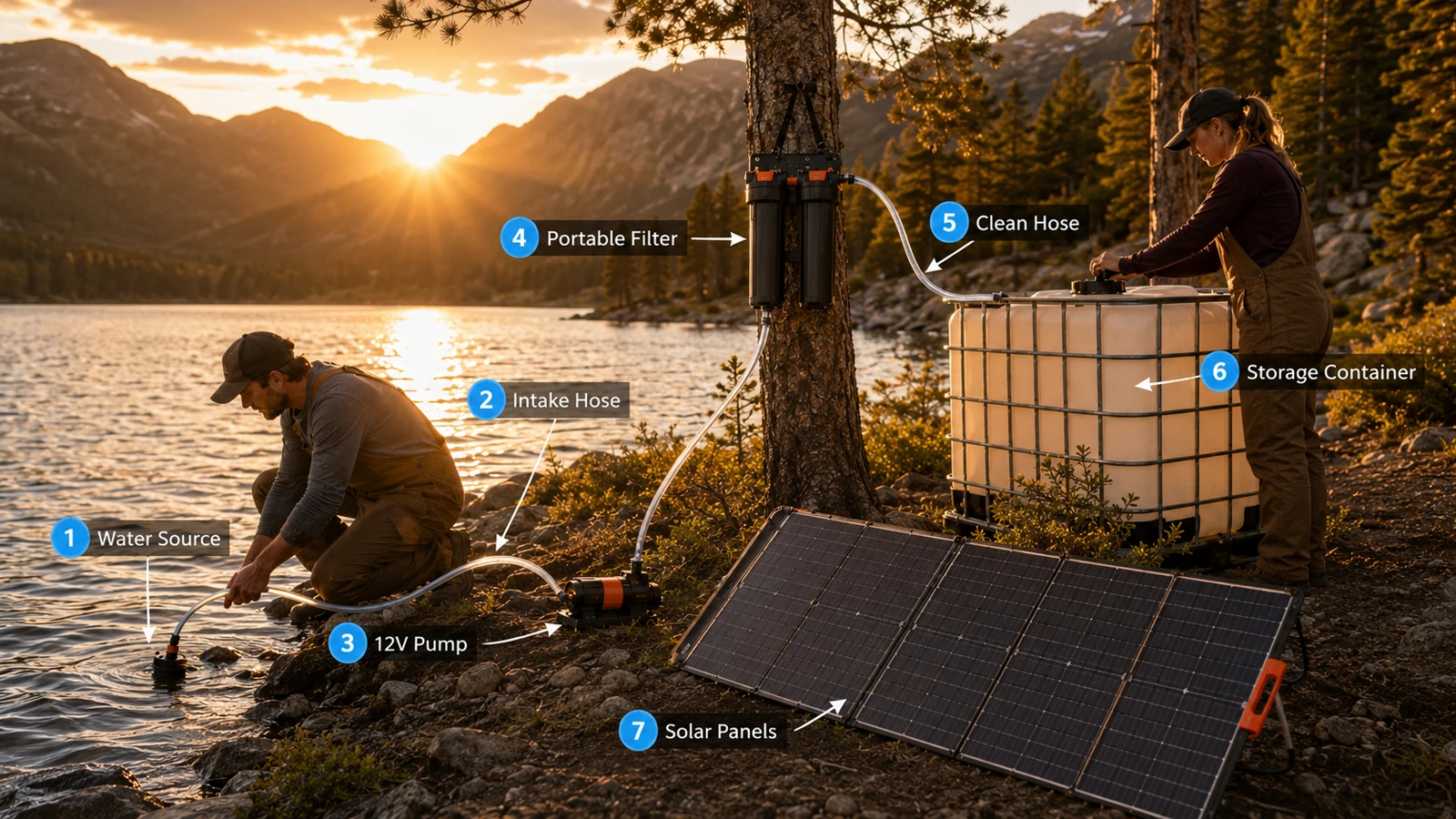
The key word is renewable. Stored water is a buffer. A portable filtration system is a supply line.
In most emergencies — even long ones — water itself is usually available. It's safe water that becomes scarce. Streams, ponds, lakes, rain barrels and even a swimming pool represent accessible water that a working filtration system can turn into drinking water on demand, with no dependence on the municipal grid or a pre-stored stack of jugs.
A practical, layered plan looks like this:
- Stored water covers the immediate window — the first 72 hours to two weeks — while you assess the situation.
- A portable filtration system extends the timeline by working with whatever sources are within reach.
- Chemical treatment (plain unscented bleach, per CDC dosing) is a backup layer when filtration isn't available.
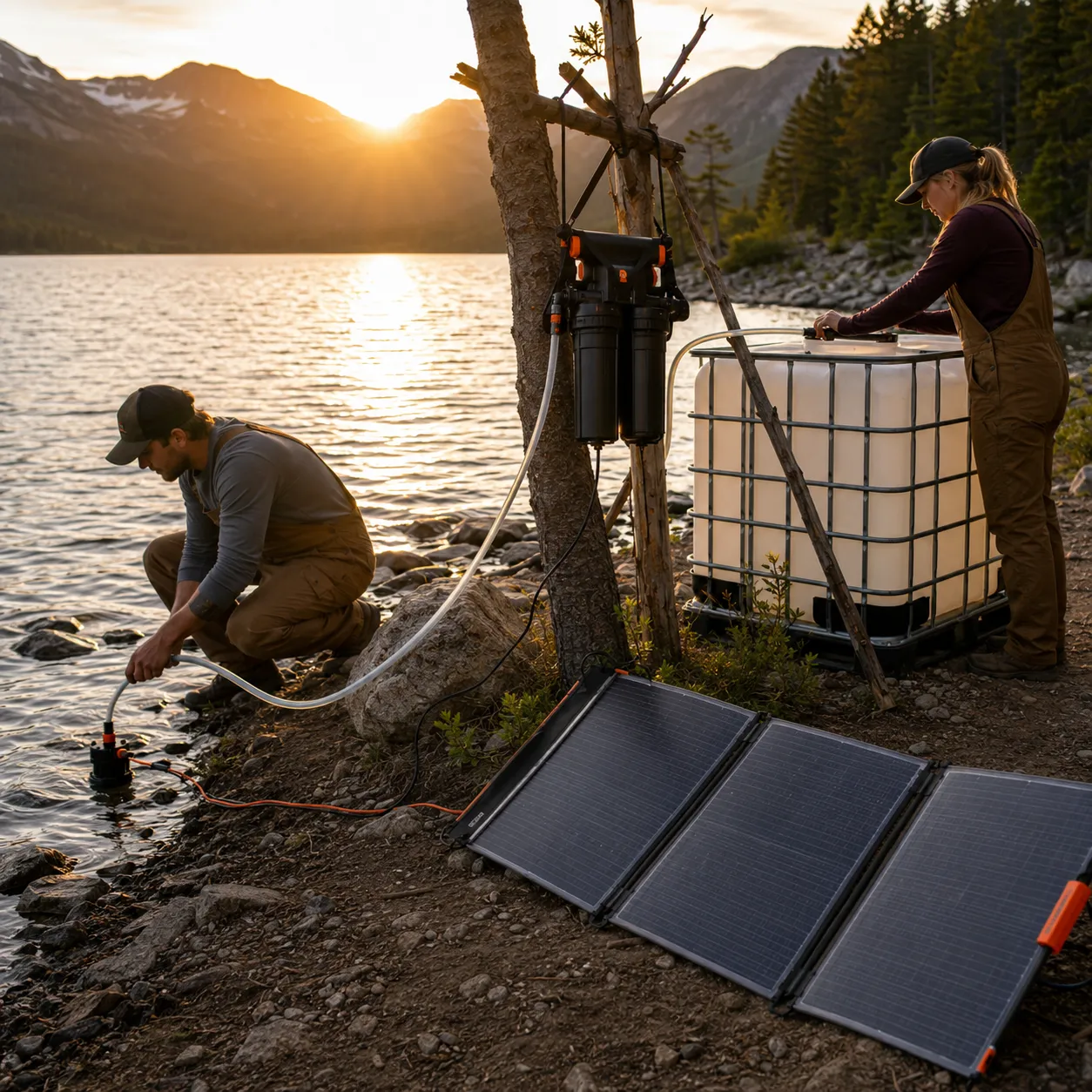
One more reason this matters for preppers specifically: power. A renewable layer shouldn't depend on the grid being up. A good portable system can run on normal pressure when you have it, a manual hand pump when you don't, or a 12V pump off a battery or a portable solar array. That flexibility is the difference between a tool that works in a real grid-down scenario and one that only works on paper.
When you're evaluating a portable system for this role, the questions that actually matter are flow rate (gallons per hour for a family, not a single hiker), power options (manual, 12V, solar), source flexibility (can it handle cloudy post-flood water, not just a clear stream), and filter lifespan. And one honest limit: no filter handles everything — heavy industrial chemicals and radiological contamination need different approaches. Know what your system targets and what it doesn't.
See the renewable layer
The Sentry H2O Portable System filters on demand — manual, battery, or solar — and works with the storage containers you already have. See the math, the source-to-storage flow, and the filter options.
Putting It Into Your Existing Prep
The goal isn't to replace stored water with a filter. It's to stop treating stored water as the only layer. A reasonable baseline for a family of four:
- Two weeks of stored water at 1–2 gallons per person per day (56–112 gallons), rotated every six months per FEMA/CDC guidance.[2]
- A portable filtration system capable of handling local water sources, with a spare filter set kept with the kit.
- Plain unscented bleach and the CDC's published dosing as a treatment backup.
The stored water handles the first window before anyone has assessed what's available outside. The filtration system handles everything after that — for as long as there's a water source within reach. The discipline that goes into serious food storage is exactly the mindset that closes the water gap. It just needs to be applied to both sides of the equation.
The Bottom Line
Your food storage is only as strong as your water plan. Stored water buys time; a renewable filtration layer is what turns "we have some water put away" into a plan that doesn't end when the barrels do. If you've already done the hard work of preparing your pantry, closing the water gap is the highest-leverage next step you can take.
Sources
[1] FEMA / Ready.gov — Water. Store at least one gallon per person per day; work toward a two-week supply.
[2] CDC — Create and Store an Emergency Water Supply. One gallon per person per day; replace stored tap water every six months.
[3] U.S. EPA WaterSense — Statistics and Facts (citing USGS): the average American uses 82 gallons of water a day at home.
[4] Standard physical constant: one U.S. gallon of water weighs approximately 8.34 pounds.
[5] Utah State University (2023), via Water Main Break Clock — approximately 260,000 water main breaks per year in the U.S. and Canada (~710/day).
[6] U.S. EPA — National Occurrence and Causes of Boil Water Advisories, Report to Congress (EPA 810-R-24-003, 2024).
[7] Lynch VD, Shaman J. Waterborne Infectious Diseases Associated with Tropical Cyclonic Storms, 1996–2018. Emerg Infect Dis. 2023;29(8):1548–1558.
[8] Medical News Today — How long can you live without water? The "rule of threes" (~3 days) is a conservative rule of thumb; actual time varies with heat, exertion and health.
Keep reading
Educational guidance on preparedness logistics — not health, medical, or safety advice for any specific water source. Filter performance depends on the filter set and source water; no system removes every contaminant.